

When Ampeleia was founded in Roccatederighi in 2002, Cabernet Franc was not an obvious choice. Quite the opposite. At a time when the taste for wine was moving towards warm, concentrated and powerful wines, we came looking for something different. High hills, cool air, woods, complex soils. A place where wine could have a different pace.
Here we also found a few rows of Cabernet Franc. We soon understood that this grape could do something important in this place. We restored the old vineyards, planted new ones and began to get to know it properly. To work with it. To make mistakes. To understand when to wait and when to stop.
In 2014, our first single-variety Cabernet Franc was born, from a specific parcel: Vigna dell’Asina, with younger vines and a higher proportion of clay in the soil. Since then, our work with Cabernet Franc has continued, following the differences between vineyards and soils. Today at Ampeleia we produce four different single-variety Cabernet Franc wines.
That means more than twenty years of working with this grape. Long enough to learn that Cabernet Franc is not a variety to be tamed. It is a variety to be listened to.

Cabernet Franc: a grape that tells the story of its territory.
Cabernet Franc has one quality that matters greatly to us: it can speak of the place where it grows.
“It is a great translator of terroir,” says Marco Tait, our winemaker.
This is, for us, what making wine is about. A bottle should first and foremost be an ambassador for the place it comes from. Not for the winemaker’s style. Not for a trend. Not for an abstract idea of wine.
When Cabernet Franc finds the right place and is guided without being forced, it has this ability. It can change considerably from one territory to another. Its aromatic profile changes, as do its structure, tannins and freshness. The way the wine feels on the palate changes, and above all, so does the way it tells the story of the landscape.
This is also why, in May 2026, we decided to organise a tasting at Ampeleia dedicated to Cabernet Franc, bringing together wines from Tuscany and the Loire Valley.
Not to decide which was better. To listen to the differences.
The Loire is one of Cabernet Franc’s great homes. Tuscany is a different territory, with a different climate, light and geology. Tasting the wines side by side allowed us to see how a grape variety can remain true to its identity while changing its voice according to the place where it grows.
For us, it was also a way to look more closely at what happens here, in the Colline Metallifere.
Cabernet Franc in Tuscany: the four expressions of Ampeleia.
Ampeleia’s vineyards lie in the heart of the Colline Metallifere. Here, you only have to move a few metres to find a different soil. This is one of the most interesting characteristics of our territory, and one of the reasons why our work with Cabernet Franc has become increasingly precise over the years.
Vigna dell’Asina was the first to give us a single-variety Cabernet Franc. The younger vines and the greater presence of clay in the soil gave us a precise expression of the grape. But it is not the only one.
Over time, we have learned to read our other vineyards and their differences. Today, four single-variety Cabernet Franc wines express four different sides of the same territory..
Ampeleia was our first wine, from the very first harvest in 2002. But it was only in 2015 that we made it a single-variety Cabernet Franc. Today it is undoubtedly the highest expression of our terroir, but also of our history. It tells our story, and the story of Roccatederighi.
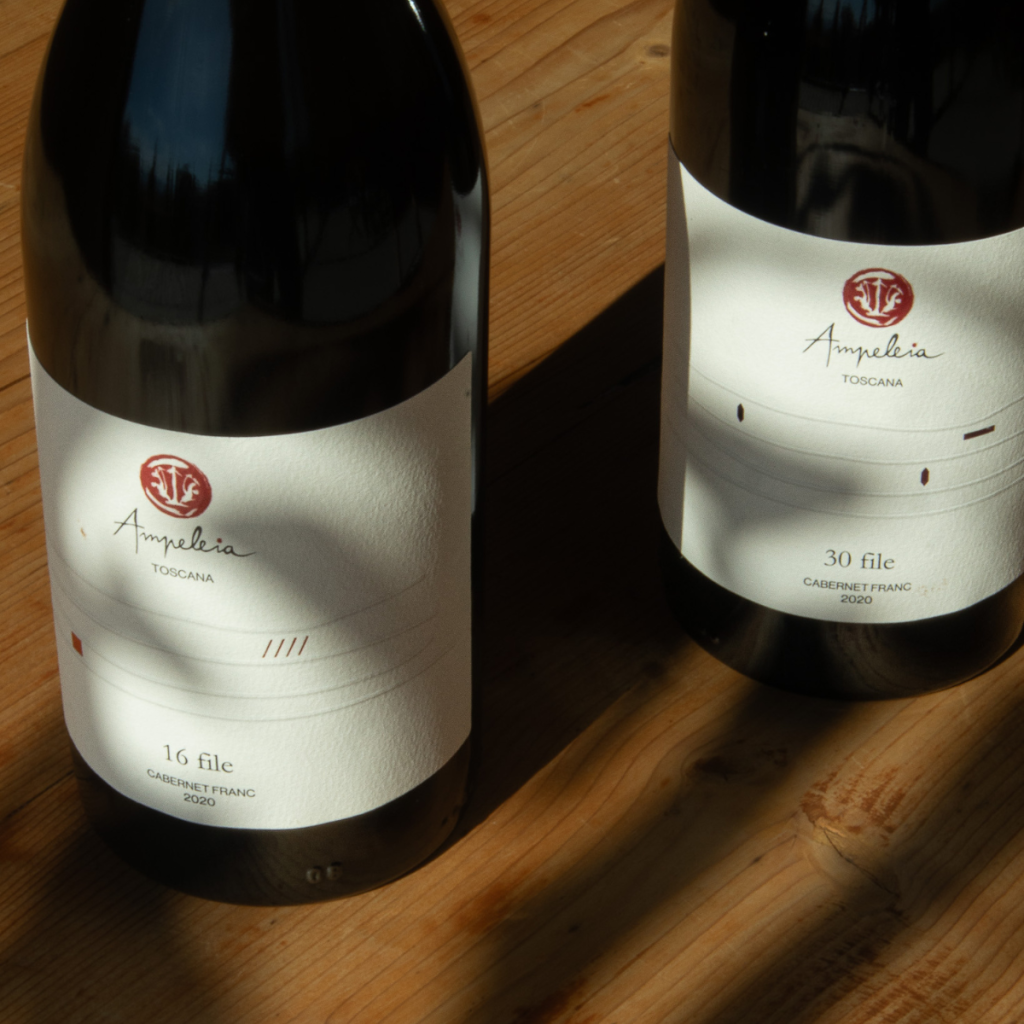
Then, in 2019, we decided to follow an instinct and what was, at the time, a slightly crazy idea: to vinify separately grapes coming not simply from a single parcel, but from an even more meticulous selection. Just a few rows, chosen from two different parts of our vineyards: only 16 rows from the Meleta di Sotto vineyard and 30 from the Brunero vineyard.
We waited. We let them mature for years. Then we presented them: 16 File and 30 File, our two Cabernet Franc crus, were born.
These wines show just how precise working with a territory can become when you choose to go deeper and deeper. From the vineyard to the parcel, from the parcel to just a few rows. Not to make things more complicated, but to understand them better.
We are not trying to make everything the same. Quite the opposite. The diversity of our soils is a richness. It allows us to understand Cabernet Franc better and to show how many different things the same grape can say when it grows in different places.
The gentleness of Cabernet Franc.
Cabernet Franc can be temperamental. It is not a grape that gives everything away immediately.
It needs to be guided. First in the vineyard. Then in the cellar, with careful attention to timing, extraction and maturation.
When it finds its balance, it can produce wines that are very different from the idea of Cabernet as necessarily muscular and powerful. It can have structure without heaviness. Tannin without aggression. Depth without over-extraction.
And above all, it can preserve freshness, tension and gentleness.
This matters greatly to us. Not because we want to put the same label on all our wines, but because gentleness is part of the way we work. It means respecting the pace of the vineyard and the seasons. It means observing before intervening. It means giving the wine the space to become what it is.
A gentle wine is not a weak wine. It is a wine that does not need to raise its voice.
Why we are still working with Cabernet Franc.
After more than twenty years, we do not think we have finished learning.
Perhaps that is the most interesting thing about Cabernet Franc. The more you know it, the more you realise how many questions remain open.
We face them every year in the vineyards and in the cellar. The result is four single-variety Cabernet Franc wines, but above all, a journey that is still continuing.
That is why, when we talk about Cabernet Franc in Tuscany, we are first of all talking from our own experience. It is a grape we have been studying for more than twenty years, in one specific place and across different vineyards. A daily practice that has taught us its sensitivity, its strength and also its temper.
We do not know where this journey will take us. But we do know that Cabernet Franc, here, still has a lot to say.
